The Rutherford experiment, also known as the gold foil experiment, was a series of experiments conducted by physicist Ernest Rutherford in 1910 that helped to understand the structure of the atom.
In this experiment, Rutherford fired positively charged alpha particles at a thin sheet of gold foil. Most of the alpha particles passed straight through the foil with little deflection, but some of them were deflected at large angles and a few even bounced back towards the source. This unexpected result led Rutherford to propose that atoms were mostly empty space with a dense, positively charged nucleus at the center.
This experiment played a crucial role in the development of the modern atomic model, which describes the atom as consisting of a positively charged nucleus containing protons and neutrons, with negatively charged electrons orbiting around the nucleus. The Rutherford experiment also paved the way for further discoveries and advances in the field of nuclear physics.
Overall, the Rutherford experiment is considered one of the most important experiments in the history of physics and it helped to lay the foundation for the development of modern atomic theory
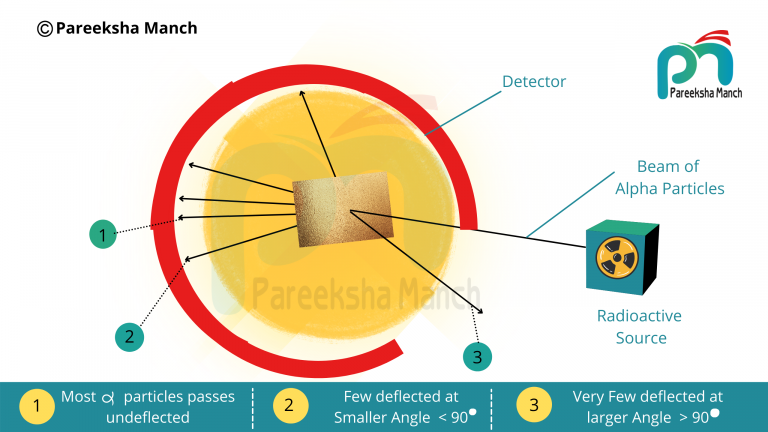
The Rutherford model proposed that the atom consists of a small, dense, positively charged nucleus at the center and electrons orbiting around the nucleus. The nucleus contains most of the atom’s mass and is surrounded by a cloud of negatively charged electrons. The model was based on the results of the gold foil experiment, which showed that most of the alpha particles passed through the foil with little deflection, but a few were deflected at large angles and a few even bounced back towards the source.
According to the Rutherford model, the positively charged nucleus is located at the center of the atom and is surrounded by one or more negatively charged electrons. The electrons orbit around the nucleus in circular or elliptical paths, similar to the planets orbiting around the sun. The model also proposed that the number of electrons in an atom is equal to the number of protons in the nucleus, which gives the atom a neutral charge overall.
The Rutherford atomic model had a few drawbacks that could not explain certain experimental observations. Some of these drawbacks include:
The model could not explain the stability of atoms: According to classical electromagnetism, an electron that accelerates around a nucleus should lose energy and eventually spiral into the nucleus, leading to the collapse of the atom. However, this was not observed, and Rutherford’s model could not explain the stability of atoms.
The model could not explain the spectral lines of atoms: When an atom is excited, it emits light at certain specific wavelengths. These wavelengths form a unique spectrum for each element. Rutherford’s model could not explain the spectral lines of atoms and why they were unique to each element.
The model did not account for the presence of neutrons: In 1932, James Chadwick discovered the neutron, which is present in the nucleus along with protons. The Rutherford model did not account for the presence of neutrons, which played an important role in determining the stability and properties of atoms.
The model did not explain the behavior of electrons in atoms: The Rutherford model did not describe the distribution of electrons in the atom and how they move around the nucleus. This was later addressed by the development of quantum mechanics.
These drawbacks led to the development of more advanced models of the atom, including the Bohr model, quantum mechanics, and the current standard model of particle physics.